
GUARDIANS will help small- and medium-sized farms bridge the current technological gap with bigger farms through the implementation of a set of digital innovative solutions.
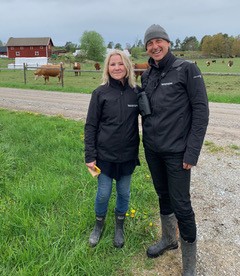
Today, we interview Inga from Lejden Farm (Märsta, Sweden).
Hi Inga!
Let’s start with describing Lejden Farm…
Our farm is located in Märsta, near Arlanda Airport, between Stockholm and Uppsala.
The history of our farm has been organic for 30 years. It is five years now that my colleague and I have taken over the farm.
We are quite unconventional as farmers; we have a little different way of looking at agriculture because we sell our animals or rent them out for grazing.
We basically create a service – that is grazing. We are also certified for semi-natural grazing.
We don’t produce milk or meat. We produce meat and skins only when animals get old, and we sell these products in our farm shop.
We have 250 hectares, 50% natural grazing, 50% for farmland.
As for the animals, we have 200 cattle more or less, three-thirds of which are meat animals, Angus, Hereford – a British breed of beef cattle – and grazing animals… But we also have a very ancient Swedish cow that we keep for biodiversity reasons.
We also have 70 sheep, mainly Swedish breeds.
We are six people working together and two dogs. My colleague and I run the business, and four employees take care of the animals. During the busy season – June to August –, when we fence and restore areas, we have two more people. And one person dedicated to the farm shop.
In the future, we would like to expand! We are looking for another farm, but it’s quite hard. The most difficult thing when you want to develop here in Sweden is where to shelter the animals in the winter. Even more so, because we are located near Stockholm, a densely populated region, which implies that there aren’t many stables around.
Tell us more about your core activities.
Our core activity is sheep and cow grazing, and we earn our income from that.
Between 1 May and 31 October, all animals are outdoors. Then, by the end of October maximum, all the animals need to be sheltered from the cold and wet weather. We have forty different lands for grazing around Stockholm, even in the archipelago! This means that we have sheep and cows going by ferry in May and October. This is quite adventurous! It is not difficult to get them out, but it’s hard to get them in again. [she laughs]
In general, as I said, we create a service using grazing for different purposes. For example, natural grazing can help improve biodiversity in wetlands and preserve lands.
Also, we keep animals to fight invasive species. And we rent them out too!
The most invasive plant species are the Japanese knotweed, giant hogweed, and fringed waterlily – which is like a normal one but it’s more invasive and it menaces freshwater sources here around Stockholm.
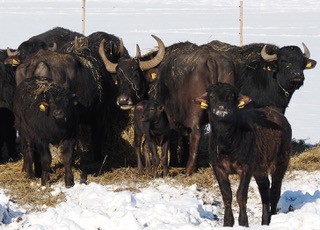
We managed to get rid of them with water buffalos and customers or authorities called us on for this service. We did a pilot for this, and we are now quite experienced. For example, we know that it takes four to five years to get rid of them by sheep grazing, and then the grass will be dominant again. Nobody knew that before. We now know it takes time, it’s a long-term result. Also, we now know that it must be sheep with black pigmentation on their face for this purpose. For example, we use a Sweden sheep from Gotland, silvery grey on the body but black-faced. If they are not black, they are more sensitive to the sun and, as a consequence, to the poison of some invasive species. That’s how the poison works…
We also have our farm shop where we sell meat, skins and some vegetables we bring from outside to make it more attractive. It is the typical old-fashioned wooden farm shop, very nice. We are located on the road between Stockholm and Uppsala with quite a lot of traffic. It works well!
Thank you, Inga, for sharing part of your daily life with us. Let’s shift to the GUARDIANS project. You are one of the farms involved in Pilot #3 where technology #8 – Biodiversity Assessment Service will be tested. What kind of challenges are you facing on your farm, and what do you hope to achieve with GUARDIANS?
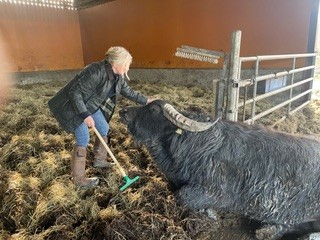
As I said, we are on the front line in fighting invasive species. And we don’t do it with traditional methods. We do it with sheep, cows or buffalos and water buffalos too. One day, we were asked to work on bigger areas with soil and masses of soil that people plough.
That’s when we met GUARDIAN with the biodiversity assessment service to check the soil with environmental DNA. This is quite new for us, but we want to be part of this project! We want to see how we can use it to be more efficient.
I think this technology will help us in a twofold sense: fighting the negative and highlighting the positive.
On one hand, when it comes to fighting the negative – such as invasive species – we could identify the areas affected by these nasty species more precisely and bring specific animal breeds based on the soil assessment. This would allow us to be more effective both in terms of time and results.
But… It could also be positive! For example, we could become inventors of soil. The soil is full of seeds and rare species. If we are aware of this, we can also promote biodiversity.
How do you feel about the use of technology for your daily work? Do you trust the technology? And to what extent do you think it will have an impact on your daily work?
We are quite used to technologies and different digital equipment, we are tech-friendly. For example, we put GPS on animals and developed an app to track – both check and find – our animals.
So, I would say we trust technology.
I always say that we are not conventional farmers, so we may have gone into this with different eyes. With my grandfather, who was also a farmer, it would probably have been different.
Technology has a great impact on our work; we could not do or think of a future without technology. We want to see what the future of grazing animals will be.
When it comes specifically to environmental DNA, it will help us be more sustainable and efficient, as I said earlier.
We will depend on high-tech to respond to our needs in the future.
For small- and medium-sized farms to be competitive in the global market, it is crucial to bridge the current technological gap with bigger farms. What are the current barriers in your opinion? What do you think is necessary to improve for more farmers to approach innovative and sustainable farming practices?
In general, my impression is that farmers tend to do what their parents have done for generations – which is good but that’s not thinking out of the box and conceiving your activity as a kind of “big company”.
As for the main barriers to the adoption of technology, the most significant ones refer to new generations not being appealed by this job. And new generations are those who can promote the use of technology in this sector. They are not encouraged mainly because of the difficult administrative procedures to apply for funds that ensure you a basic income. You depend on a very complicated set of rules which makes it difficult even to understand what you can rightfully apply for. If you succeed with the application, then the control system sends you the agricultural regional authorities to check the farms, the animals, the wetlands… And the funds depend on the number of animals you keep, or if you are organic or not… It’s very confusing, long and uncertain. You need to be very stubborn, collect cross-references and spend a lot of time in front of the computer. But, you know, you are not a farmer because you want to sit in front of a computer… new generations know it very well.
In general, this is a threat for small- and medium-sized farmers who really depend on this money for their development and investments in technologies.
We haven’t received any training or push from authorities; this would help but the first obstacle to overcome is administrative procedures…
And, on the other hand, what would you suggest farmers do to approach, understand and potentially evaluate the use of new technologies in the agri-food sector?
I would suggest that they be patient with technology. You may not see immediate results, but real support and impact come in the long term.
For example, as I said, we have our customers (like municipalities) who want some areas in the archipelagos, forests or wetlands to be grazed to get rid of reed for example. We put trackers on water buffalos or cows and let them graze that area for a certain amount of time.
When it comes to justifying our work, we can print out the monitoring results and we can actually prove all our activities through pictures and real data. This makes everything easier.
In general, it would be helpful to get informed and see previous tests and results to become more confident. You need good examples first!
Thank you for this inspiring interview, Inga!
Stay tuned for the next Farm Stories interview.
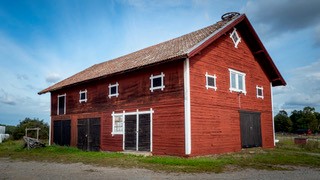
Cover picture by Damir Korotaj on Unsplash.